Showing posts with label wool sheep Corriedale Wovember. Show all posts

Tuesday, November 05, 2013

Wool Washing, Part 2

Now we're on to STEP 2: WASHING  , but before we proceed please be sure you have read Step 1 here (especially the disclaimer that this is how I do it, in my own home, taking my own chances with the entire procedure.  How it works for you is entirely your responsibility and I make no claims or guarantee of your success)

First wash
First of all, you want your wash water VERY hot ~ to hot to put your hand in comfortably ~ mine is 160 degrees.  (NOTE  If needed,  you can boil water on the stove and add to your tub to increase the temp. You can also fill a large stock pot with water; bring to the boil; shut the water off; add the soap then fleece; cover and let soak right on the stove.  I find this works well for mohair. The hard part to this is lifting the heavy pot when it comes time to change water!) Anyway, fill your container with this hot water and then be generous with the soap (use enough to color the water) Do not swish the soap around, you don't want lots of extra bubbles, just good soap and hot water.  Cover your container somehow to help hold the heat in and then let the fleece soak in there for maybe 10 to 15 minutes (don't allow the water to cool much)  Drain the water away, take your wool out and repeat this process (filling the container with hot water, then soap, then wool).  You will probably need at least two, maybe three, washes.  In this case, Daniel's fleece required two wash cycles.

Second wash
Now comes STEP 3:  RINSING  No matter how many wash cycles I have put the wool through, I always do at least two rinses.  Sometimes there are more rinses than washes, just to get all of the soap out!  The first rinse water is as hot as the wash water and has a generous "glug" of white vinegar.  I do have a water softener, but it just seems to help cut the soap to use the vinegar (maybe that is just my imagination though)  Anyway, into the hot water and vinegar goes the fleece to soak for about 10 minutes.  Drain, remove fleece, refill container with hot water (no vinegar this time) and rinse again without agitation for 10 minutes or so.  Repeat if you are still getting soap bubbles in your rinse water.  Please do not ever add hair conditioner or softener to your wool!!!  I don't know of any fiber mill that will take wool that has been "conditioned" without re-washing it.  Wool is NOT hair!

Daniel's clean fleece, fresh out of the rinse
STEP 4:  I like to remove the excess water as much as I can.  If the fleece is in my washing machine, I spin it out with no water - I have an older machine that allows me to do this.  For small batches, you can dedicate an old salad spinner to spinning wool ;)  Now you will lay the clean fiber out somewhere to air dry.  Its hard to wait, but you want it to be completely dry before you start processing it.   You will notice that although the tips of this fleece remain slightly discolored (see the photo above), it looks nothing like the dirty tipped fiber it started out to be!  It might be important to mention that because this fleece was coated, although it is dirty (sweat, lanolin, dirt and mud) it is NOT full of vm and chaff, so is relatively easy to get clean.


Now, remember that dirty fleece we started with (above)?  See how beautiful it is now (below)?


What a joy and a pleasure, with very little effort!  Especially if you are experimenting with only a few ounces at a time.  Here we have this lovely lambs fleece, ready to prepare to spin - in this case, Daniel's very fine Corriedale wool is destined for the wool combs and then on to spinning.  I hope these few tips of a simple way to wash a fleece will help someone out, and if you experiment with just those few ounces if it gets ruined or doesn't turn out you won't have lost an entire fleece trying.  I'd love to hear how it turns out for you if you do try, or if you have any questions I'd be happy to try and answer them.


Monday, November 04, 2013

Wool Washing, Part 1

When we used to have an active webpage, I had this article about how I wash our Corriedale wool.  It was a popular page, and I still get asked a lot about washing wool, so I thought I would try to recreate it here on the blog rather than rewriting the whole thing (so the photos you see are from 2008!)  Procedure for me is still the same and because I'm washing some wool right now for my Wovember project, I think its a perfect time to share!

WASHING CORRIEDALE WOOL the way I do it:

This first photo is of a raw lamb fleece belonging to DANIEL, a coated Corriedale wether (yes,he WAS coated even though the tips of his fleece are very dirty). Lamb fleeces are my most requested item and I charge a premium for it (after all, a sheep onlyhas one lamb fleece in its lifetime!) But lamb fleeces can be a challange...they are usually dirtier, even though the lamb is coated from about 3 months on.  And they are generally very fine and can be delicate.  But what a reward at the end!.  Anyway, I wash all Corriedale fleeces the same...I just chose a lamb fleece for this example so that you can see how it goes from grungy to sparkling.

For this demonstration, I'm washing just a few ounces of fleece in a sink.  If I'm washing an entire fleece, I do it in my washing machine, a few pounds at a time, filling the tub first with the water, adding the fiber, then spinning the excess dirty water out WITHOUT agitating or running water on the fiber.  I remove the wet fiber, refill the washtub, replace the fleece and start the process over again.  This works for me and has for several years, but I will NOT recommend that you put wool in your washing machine as this could cause problems.  To be safe, you could fill a dish pan or bucket outside in your yard, follow the steps below and wash your fleece that way.  Only you can decide for your own situation.  I am just going to share with you how I get my wool clean ;)  Lets get started....

STEP 1: COLD WATER SOAK  Fill your basin or container with cold water, no soap.  Lay the fleece in the water, pushing it down gently if you need to.  I generally leave it to soak for about 10 - 20  minutes.  You can see what the water looks like in the photo above.  Remember, this water contains NO SOAP and is COLD!  I read this tip from someone who raised Merino sheep many years ago (I wish I could remember who to give credit to, but I can't)  To me, this makes a huge difference to the cleanliness of my lanolin laden, fine wooled Corriedale sheep.

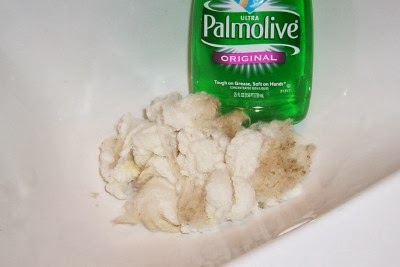
Compare the picture to the left, which is the fiber that has been soaked in cold water only, and the picture below, which is the unwashed fiber...can you believe what a difference just a cold water bath has done?  It has loosened things up, removed a lot of the sweat and it seems to me it gets the fleece ready for the next step....the real wash!  See the dish soap in the picture?  That is the brand I prefer, though many recommend the blue dish soap or even a horse shampoo.  I like this one, it works well for me.  I never use the horse shampoo many mention...we didn't use it on our horses when we raised them because we could never get it rinsed well!  Human shampoo or pet shampoo is worthless for washing wool, in my experience and opinion. I have used Shaklee liquid soap with some success.


So now we've given the wool a cold soak, gently lifted it out of that cold water and even given it a gentle squeeze, and set it aside while we drain away the greasy cold water.  Tomorrow I'll show you the next step in my wool washing procedure - I hope you'll come back!  Maybe this picture of Daniel the lambs sweet face will entice you?